
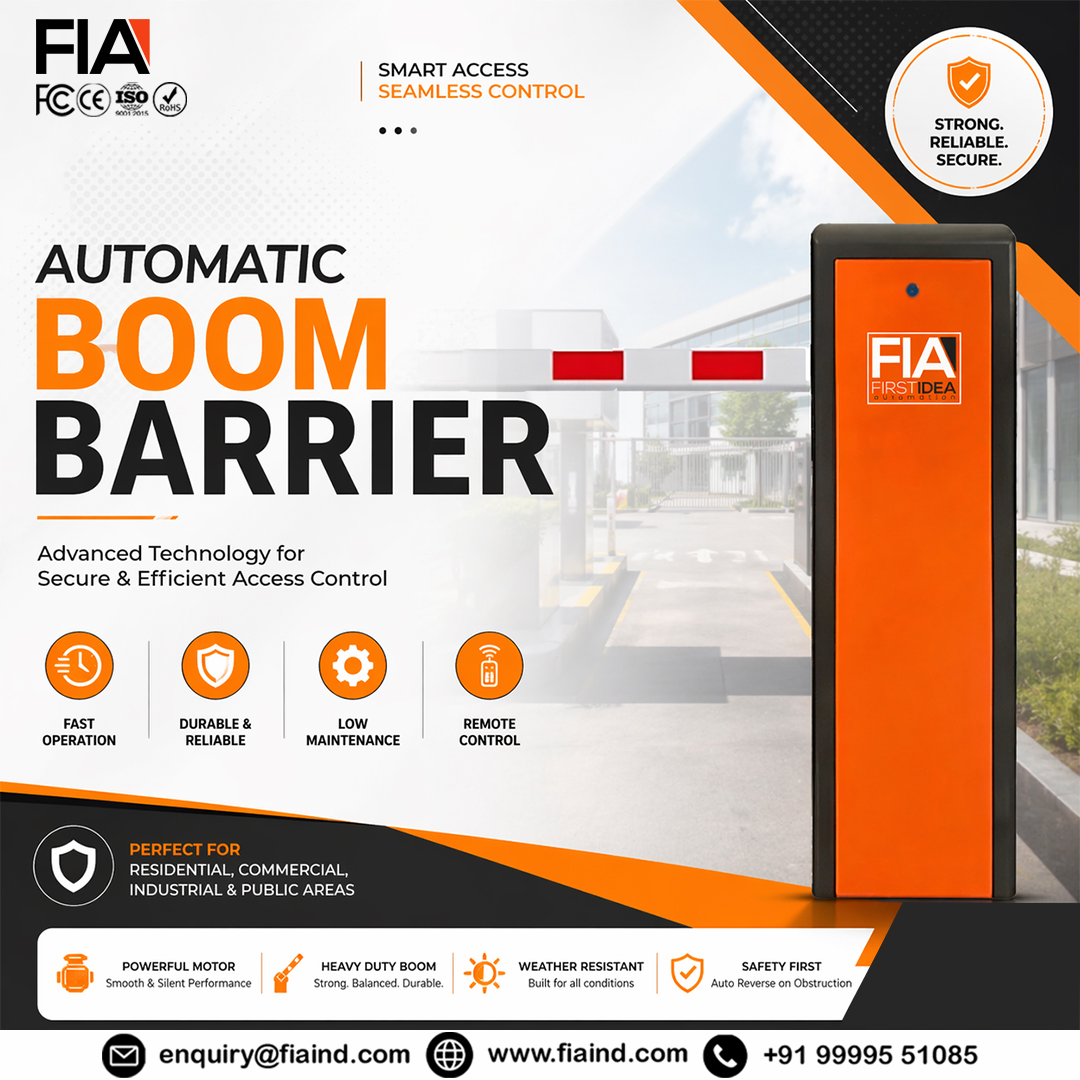
Anyone can find articles explaining what a barrier does. Almost none explain how to vet a vendor before you sign a purchase order. A barrier often fails eighteen months into a five-year expected lifespan. Then the conversation always shifts to the same regret: “we should have asked more questions before buying.” This article flips the order. It gives you the questions first, before the invoice, before the installation, and before the first service call reveals whether you chose well.
Why the Standard Buying Process Fails Facility Managers
Most procurement conversations around a boom barrier start and end with three variables: price, arm length, and delivery timeline. These are the easiest things to compare on a spec sheet. That’s exactly why vendors lead with them. But none of these three factors predict how the barrier will perform under your traffic load. They don’t predict how it will hold up in your climate, over a multi-year lifespan. A familiar pattern shows up across residential societies, corporate campuses, and industrial sites. A barrier looks identical to competitors on paper. Then it fails within a fraction of its expected service life, because nobody asked the harder questions upfront.
Below is a structured way to test any vendor’s claims, including FIA’s. Use it to base your decision on operational fit, not brochure language.
Question 1: What’s the Rated Duty Cycle, and Does It Match Your Traffic?
Ask every vendor directly: “What’s the rated duty cycle of this model? How does it compare to my site’s peak-hour vehicle count?” Most sales conversations skip this step and jump straight to price. Consider a barrier rated for light residential use, around 20 to 30 operations per hour. Sell that same barrier into a commercial site with continuous vehicle movement, and you get a warranty claim waiting to happen. The motor simply wasn’t built for that workload, no matter how well the manufacturer built it.
Duty-cycle transparency separates serious manufacturers from generic suppliers. FIA publishes duty-cycle figures for each model. This lets you run the comparison before installation, not after the motor overheats and fails. Before you open a conversation with any vendor, count your own peak-hour vehicle movements. Use that number, not the price list, as your starting point.
Question 2: How Does RFID Integration Actually Work?
Suppose contactless entry matters to your facility. Don’t settle for a vendor who simply confirms that the barrier “supports RFID.” That phrase means almost nothing on its own. Ask how the integration actually functions. A genuinely integration-ready RFID boom barrier should let you specify several concrete details:
- Tag-read range — Short-range windshield tags typically work within a few centimeters to a meter. Long-range vehicle tags can trigger the barrier from several meters away. This distinction matters enormously for traffic flow at high-speed entry points.
- Database synchronization — Does the controller sync with your existing visitor-management system, ERP software, or society-management app? Or does it operate as an isolated unit that needs manual data entry?
- Logging behavior — Does the system timestamp every entry and exit automatically? Or does someone need to export logs manually for auditing?
- Tag provisioning — How easily can you add or remove vehicles from the authorized list? Can your own staff manage this, or does it require the vendor every time?
A confident vendor answers these questions with real installation examples, not generic marketing copy. That confidence tells you far more about product maturity than any specification sheet. This distinction matters because RFID retrofits happen after a standard barrier is already installed. Technicians can add the technology later, but the result rarely runs as smoothly as a system designed for RFID from day one.
Question 3: What’s the Actual IP Rating?
“Weatherproof” is marketing language with no enforceable meaning. IP54, IP55, IP65: these are real specifications with defined thresholds for dust and moisture ingress. They matter enormously depending on where your facility sits. Coastal facilities need higher ingress protection against salt spray. Salt corrodes unprotected metal components within a single year if the housing isn’t sealed properly. Dusty industrial zones need sealed control boxes, too. Dust builds up on internal circuitry and causes intermittent failures that are maddening to diagnose. A credible vendor gives you the exact IP rating for your specific model. They won’t just reassure you that “it’s built for outdoor use.”
Question 4: What Happens During a Power Cut?
Facility managers often forget this question until the exact moment they need the answer. Picture an outage during a shift change, a delivery rush, or a visitor influx, with vehicles queuing at the gate. Confirm upfront whether the system includes battery backup, offers it as an add-on module, or skips it altogether. Ask how many operational cycles that backup sustains before it needs recharging.
This single detail separates two very different outcomes. One barrier quietly absorbs outages. The other turns every power cut into a manual-override incident, with security staff physically lifting a motorized arm. That kind of manual lifting stresses the mechanism and often voids warranty coverage on the gearbox.
Question 5: How Deep Is the Safety Redundancy?
Most barrier installations use a single photoelectric sensor as standard. But standard isn’t always sufficient for every environment. Pedestrians and vehicles often share the same lane in residential societies, hospital campuses, and mixed-use commercial complexes. In these cases, ask specifically whether dual-sensor configurations or force-sensitive edge protection are available.
Don’t treat this as a luxury upgrade to skip for budget reasons. It’s a liability question with real consequences. A single sensor can miss a low object. It can also fail during bright, low-angle sunlight that interferes with infrared detection. A vendor serious about safety compliance should walk you through redundancy options without hesitation. They should also explain the failure behavior: does the barrier default to open, default to closed, or simply refuse to move when a sensor malfunctions?
Question 6: What Does the Service Network Actually Look Like?
The arm, the motor, the housing: these are the visible, easily photographed components that dominate product listings. What’s harder to evaluate upfront, and far more consequential over time, is what happens eighteen months in, when a part needs replacing or the control board develops a fault. Ask directly:
- How many service centers cover your specific region? What’s the average response time for a service call?
- Do local technicians stock spare parts, or does the vendor ship them from a central warehouse? A shipping delay can leave your barrier non-functional for days or weeks.
- Does the vendor offer a maintenance contract? What does it actually cover: routine inspection, parts replacement, or both?
A regional support network becomes genuinely relevant at this stage of the decision. In practice, a barrier is only as reliable as the speed of repair when something goes wrong. Verify FIA’s regional service coverage directly with references in your area. Don’t take vendor claims at face value during a sales conversation.
Read More Details: https://www.fiaind.com/products/automatic-boom-barrier/
Building a Side-by-Side Scorecard
When you compare vendors to find the best boom barrier for your site, resist the instinct to compare price first. Price comparisons without context almost always favor the vendor who cut corners somewhere less visible. Instead, score each vendor across five categories: duty-cycle transparency, RFID integration depth, IP rating specificity, power-backup availability, and service network coverage. Weight each category based on what matters most for your facility. A coastal industrial site should weight IP rating heavily. A high-traffic corporate campus should weight duty cycle and RFID integration more heavily.
A vendor that scores well across all five categories will often cost more upfront. Even so, that vendor will almost always cost less over a five-year ownership period than the cheapest unit on the list. Factor in premature part replacements, extended downtime, and the labor cost of managing repeated service calls, and the math shifts quickly.
The Real Takeaway
The barrier itself has largely become a commodity component. The genuine differentiator today is transparency: how clearly a vendor answers hard operational questions before the sale, not after. Facilities that work through these six questions upfront consistently report fewer service calls. They also report longer equipment life and fewer unplanned downtime incidents than facilities that compared spec sheets and price tags alone.
Before your next purchase decision, run every vendor you’re considering through this checklist, including FIA. Pay attention to the clarity, specificity, and confidence of their answers. That will tell you more about long-term reliability than any brochure, product photo, or price quote ever will.
 admin