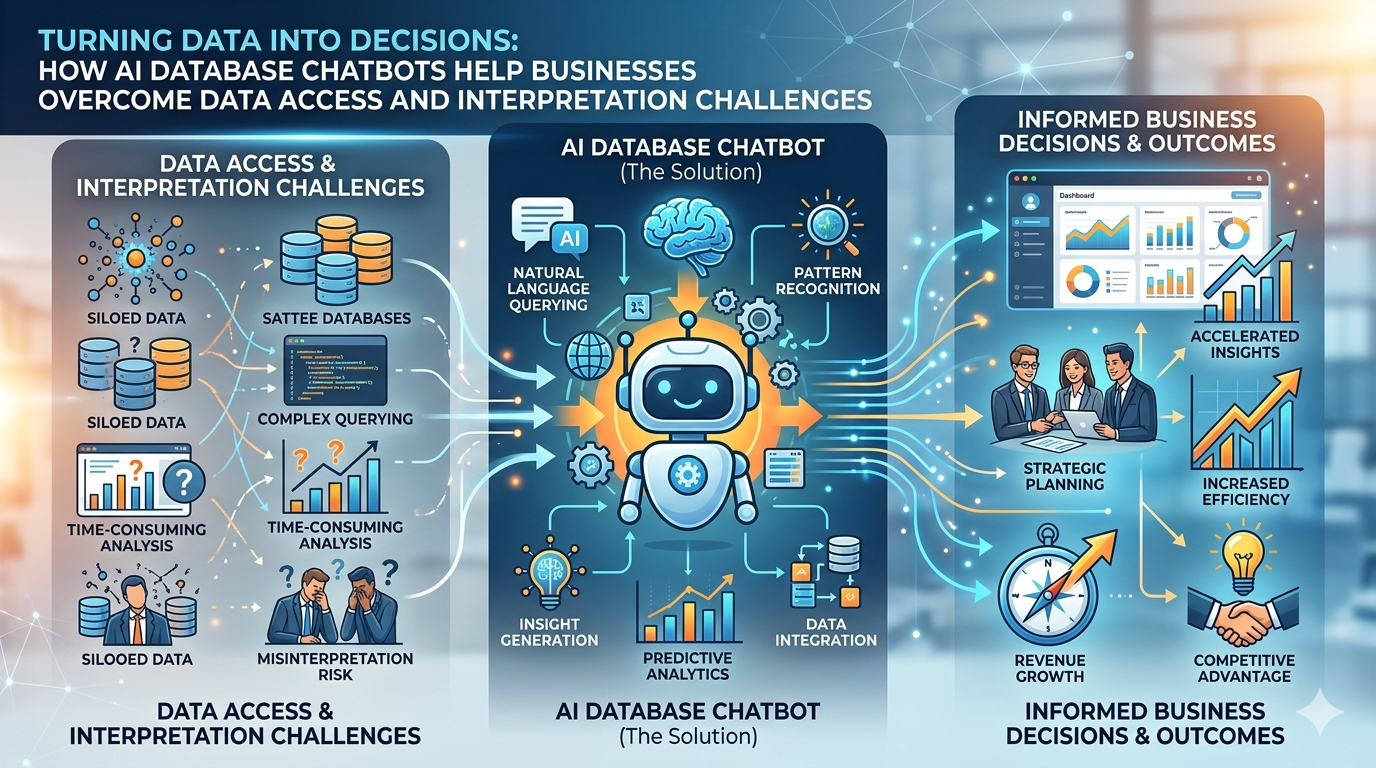
Modern businesses generate vast amounts of data across multiple systems, including databases, dashboards, CRM platforms, and spreadsheets. Despite this abundance, many organizations still struggle to extract meaningful insights in a timely and efficient manner.
The challenge is not the lack of data, but the difficulty in accessing and interpreting it.
Through advancements in AI database chatbot development, businesses are beginning to adopt conversational interfaces that simplify how users interact with structured data. Instead of relying on technical expertise or manual reporting, teams can now retrieve insights by simply asking questions in natural language.
This shift is particularly important as organizations scale and data complexity increases. Traditional tools often fail to keep pace with the growing demand for real-time insights, leading to bottlenecks in decision-making. Employees may spend significant time searching for information or waiting for reports, which slows down operations and reduces overall efficiency. Conversational AI bridges this gap by enabling faster, more intuitive access to data, empowering teams to explore information independently and make informed decisions without unnecessary delays.
The Ongoing Challenges in Data Access and Interpretation
Organizations have invested heavily in building data infrastructures, yet several persistent challenges continue to limit their effectiveness. Common issues include:- Dependence on data analysts for routine queries
- Delays in retrieving insights due to manual processes
- Static dashboards that do not support flexible exploration
- Data silos across multiple disconnected systems
- Limited ability of non-technical users to interpret data
How AI Database Chatbots Are Transforming Data Access
Conversational AI is emerging as a practical solution to bridge the gap between users and data systems. With database chatbots, users no longer need to understand database structures or write SQL queries. Instead, they can ask questions such as:- “What was the revenue last month?”
- “Which product performed best this week?”
- “Which region showed the highest growth?”
The Complexity of Data Interpretation
Even when data is accessible, interpreting it remains a challenge for many organizations. Raw data often lacks context, making it difficult for users to derive actionable insights. For example:- Reports may highlight declining performance without identifying causes
- Customer datasets may not reveal behavioral trends
- Dashboards may present figures without meaningful explanations
- Summarized insights
- Comparative analysis
- Trend explanations
- Context-aware responses
The Importance of AI Model Training
To deliver accurate and relevant insights, AI systems must understand business-specific terminology and data structures. This is where AI model training plays a critical role. By training models on domain-specific datasets, organizations can ensure that chatbots:- Recognize internal terminology
- Understand key performance indicators
- Interpret complex queries accurately
- Deliver contextually relevant responses
Integration with Enterprise Systems
Modern organizations operate across multiple platforms, including CRM systems, ERP tools, analytics platforms, and internal databases. Effective implementation of AI database chatbots requires seamless integration with these systems. Through comprehensive AI development services, businesses can connect conversational interfaces with their existing technology stack. This allows users to:- Access data from multiple sources
- Ask cross-functional questions
- Receive unified insights
Business Impact of AI Database Chatbots
Organizations adopting AI database chatbots are experiencing measurable improvements in various areas. Key benefits include:Faster Decision-Making
Access to real-time insights enables quicker and more informed decisions.Reduced Workload for Data Teams
Routine queries are automated, allowing analysts to focus on advanced analytics.Increased Productivity
Employees spend less time searching for data and more time applying insights.Data Democratization
Non-technical users gain direct access to data, promoting a more data-driven culture.The Future of Conversational Data Systems
AI database chatbots represent an early stage in the evolution of conversational data systems. Future developments are expected to include:- Context-aware multi-step conversations
- Proactive insight generation
- Voice-enabled data interactions
- Integration with predictive analytics
The Role of AI Development Agencies
Conclusion
While businesses continue to generate increasing volumes of data, challenges in accessing and interpreting that data remain significant. AI database chatbots provide a practical solution by enabling conversational access to structured data and delivering meaningful insights in real time. As organizations continue to adopt AI-driven technologies, conversational data systems are expected to become a core component of modern business infrastructure, helping companies make faster, smarter, and more informed decisions.FAQs
1. What are AI database chatbots and how do they work?
AI database chatbots are conversational systems that allow users to interact with structured data using natural language. Instead of writing SQL queries or navigating complex dashboards, users can simply ask questions like “What were last month’s sales?” The chatbot interprets the query, converts it into a database request, retrieves relevant data, and presents the answer in an easy-to-understand format. These systems combine natural language processing, database querying, and response generation to simplify data access.
2. Can non-technical teams use AI database chatbots effectively?
Yes, one of the biggest advantages of AI database chatbots is that they are designed for non-technical users. Teams such as marketing, sales, operations, and customer support can access data without relying on analysts. This improves productivity and enables faster decision-making across departments.
3. How accurate are AI database chatbots?
Accuracy depends on factors like data quality, system design, and AI model training. When properly trained on business-specific data and integrated with well-structured databases, these chatbots can deliver highly reliable results. Continuous optimization further improves performance over time.
4. Are AI database chatbots secure for business use?
Yes, enterprise-grade implementations include strong security measures such as role-based access control, data permissions, and secure API connections. This ensures that users can only access data relevant to their role while protecting sensitive business information.
About The Author

Leave a Reply