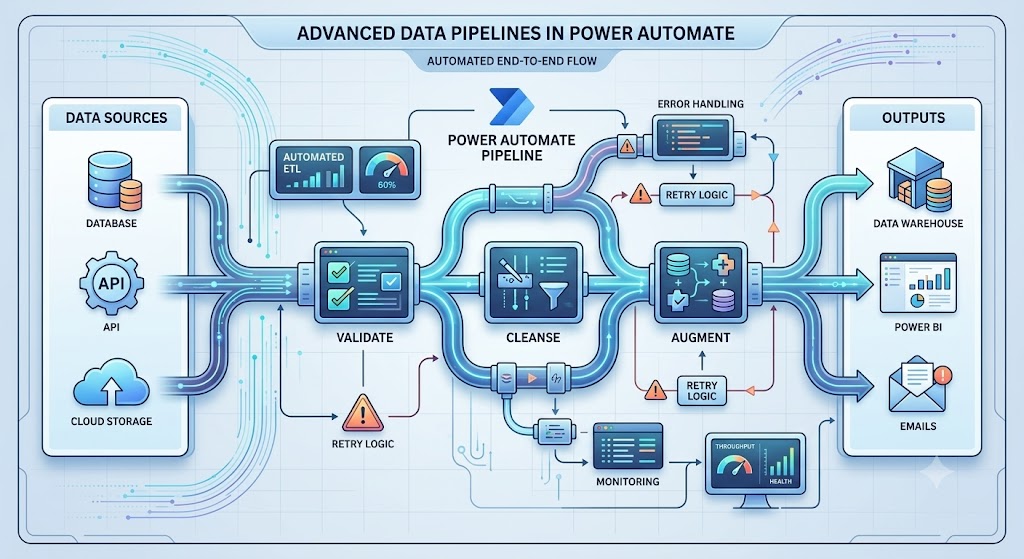
Let’s be honest about how most organizations start their journey by data pipeline with Microsoft Power Automate. It usually begins with a single, simple need: someone gets tired of manually downloading email attachments and saving them to SharePoint, or a manager wants an automated Teams ping whenever a new lead is added to the CRM. Within a few clicks, the flow is built, the time is saved, and the magic of low-code is realized.
But as adoption grows, so does the ambition. IT Managers, Operations Directors, and CTOs quickly realize that if a platform can handle simple notifications, it should theoretically be able to handle complex, multi-system data synchronization. Suddenly, you aren’t just sending emails; you are attempting to build enterprise-grade data pipelines, orchestrate massive ETL (Extract, Transform, Load) processes, and integrate legacy on-premise databases with modern cloud infrastructure.
This is where the training wheels come off. Moving from basic task automation to advanced data pipeline architecture requires a fundamental shift in how you design, build, and govern your workflows. If you treat an enterprise data pipeline like a glorified email autoresponder, you will inevitably end up with fragile, unmanageable spaghetti code that breaks at the worst possible moments.
Here is a deep dive into how to architect robust, scalable, and advanced data pipelines using Power Automate, and how to recognize when your organization needs to rethink its low-code strategy.
The Evolution: From Task Automation to Data Pipelines
A simple workflow reacts to an event. A data pipeline manages the lifecycle of information.
When you build a data pipeline in Power Automate, you are taking on the responsibility of data integrity. You are extracting thousands of rows of data from an external API, transforming that payload—filtering out null values, converting time zones, cross-referencing IDs—and loading it into a secure repository like Microsoft Dataverse.
This requires moving away from linear, step-by-step thinking. Advanced Power Automate architecture demands parallel processing, robust error handling, and a deep understanding of JSON parsing and API limits. The platform is incredibly powerful, but it will only scale as well as the logic you build into it.
Mastering Complex Logic Structures and Expressions
The visual drag-and-drop interface of Power Automate is a double-edged sword. It makes building easy, but it can make complex logic incredibly cluttered. If you have ever scrolled through a flow with ten nested “If/Else” conditions, you know exactly how unreadable it can become.
To build enterprise pipelines, you have to master advanced logic structures and rely heavily on Workflow Definition Language (WDL) expressions.
1. Condensing Logic with Expressions Instead of using visual action blocks to format dates or check for null values, push that workload into expressions. Functions like coalesce() are lifesavers. If you are mapping data from an API to Dataverse and aren’t sure if a field will be populated, coalesce(triggerOutputs()?['body/Company'], 'Unknown') handles the null exception gracefully in a single line, rather than requiring a massive condition block.
Similarly, mastering string manipulation (substring, split, replace) and mathematical expressions allows you to transform data payloads cleanly within a “Compose” action before you ever attempt to load it into your database.
2. Implementing State Machines and Switch Cases Nested conditions are the enemy of scalable flows. If a data pipeline needs to route information based on five different regional codes, do not use nested “If/Else” blocks. Use the “Switch” control. It keeps your architecture flat, readable, and incredibly easy to update when a sixth region is inevitably added next quarter.
3. The Try-Catch Pattern for Error Handling In enterprise data pipelines, failures are not a possibility; they are an inevitability. APIs time out, APIs change their payload structures, and external servers go down.
Advanced Power Automate developers handle this by implementing the “Try-Catch” pattern using Scope blocks. You group all your execution actions inside a “Try” scope. Immediately following it, you create a “Catch” scope, configuring its “Run after” settings to only execute if the “Try” block fails or times out. Inside the Catch block, you can capture the exact error message, log it into an administrative Dataverse table, and send an actionable alert to the IT team, all while allowing the flow to terminate gracefully rather than just silently failing in the background.
Architecting Integrations: Dataverse and External APIs
A data pipeline is only as good as the systems it connects. While SharePoint and Excel are fine for basic lists, they are not relational databases and should never be used as the backbone of an enterprise data pipeline.
The Power of Dataverse When you are moving beyond basic flows, Microsoft Dataverse becomes your best friend. It provides strict relational database rules, role-based security, and complex data modeling capabilities. When Power Automate interacts with Dataverse, it does so natively and incredibly fast. You can use advanced OData filter queries to ensure your flow only pulls the exact delta of records that have changed since the last run, rather than polling the entire database and burning through your API request limits.
Mastering External APIs and Custom Connectors Eventually, you will need to pull data from a system that doesn’t have a pre-built premium connector. This requires using the HTTP action or building a Custom Connector.
When working with REST APIs in Power Automate, you have to account for pagination. If an external system limits API responses to 100 records per call, but you have 5,000 records to sync, you must build a “Do Until” loop structure that checks for a pagination token in the API response and continues to make calls until all data is retrieved.
Furthermore, you must manage concurrency control. By default, “Apply to each” loops run sequentially. If you are updating 1,000 records, this will take a frustratingly long time. By venturing into the settings of the “Apply to each” loop and turning on Concurrency Control, you can process up to 50 records simultaneously, drastically reducing the time your data pipeline takes to execute.
The “Low-Code Ceiling”: Recognizing When You’ve Hit the Wall
Despite its immense capabilities, there comes a point where organizations hit the “low-code ceiling.” This isn’t necessarily a limitation of the Microsoft ecosystem itself, but rather a limitation of how the workflows were initially cobbled together.
You know you’ve hit this wall when:
-
Flows have become “Monster Flows”: You have flows with hundreds of actions that take minutes just to load in the browser. They are terrifying to edit because changing one variable breaks five downstream actions.
-
Licensing Costs are Spiraling: You are burning through Power Platform request limits because flows are polling databases inefficiently rather than using webhook triggers.
-
Governance is Non-Existent: You have critical business operations running on flows tied to a single user’s personal credentials. If that employee leaves the company, the entire data pipeline collapses.
-
Shadow IT has Taken Over: Departments are building their own siloed integrations without IT oversight, resulting in duplicated data and security vulnerabilities.
When a company reaches this inflection point, the solution isn’t to abandon low-code; the solution is to introduce professional architecture. This is exactly when it becomes necessary to engage professional Microsoft power platform consulting services to audit the environment. A proper consulting intervention can help untangle the mess, implement Application Lifecycle Management (ALM) using Solutions, and establish a Center of Excellence (CoE) to enforce governance and security policies across the tenant.
The Path Forward: Restructuring for Scale
Scaling Power Automate requires treating it with the same respect as traditional pro-code development. This means moving away from building flows in the “Default” environment and adopting a strict Dev-Test-Prod deployment lifecycle. It means using Environment Variables for API keys and SharePoint site addresses so that flows can be seamlessly migrated between environments without manual reconfiguration.
It also means breaking down monolithic flows into modular, reusable components. Instead of one massive pipeline, you create a “Parent” flow that triggers several “Child” flows. One child flow might handle the data extraction, another handles the transformation logic, and a third handles the Dataverse insertion. This modular architecture makes troubleshooting infinitely easier and allows different teams to maintain different parts of the pipeline.
Conclusion
Power Automate is far more than a simple task runner. When leveraged correctly, it is a formidable enterprise integration engine capable of orchestrating complex data pipelines across disparate systems.
Moving beyond basic flows requires a commitment to learning advanced logic structures, mastering Dataverse integrations, and embracing professional development protocols.
About The Author