Introduction
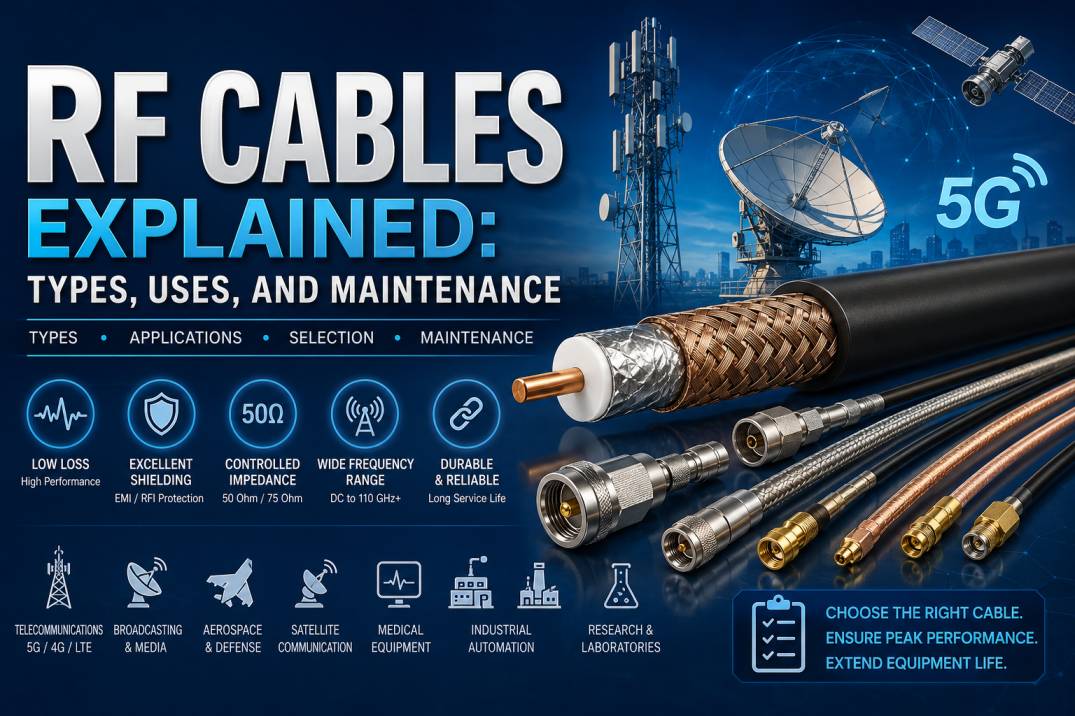
RF (Radio Frequency) cables play a vital role in transmitting high-frequency electrical signals between antennas, transmitters, receivers, and RF equipment. Whether it is a 5G network, satellite communication, radar system, or laboratory test setup, RF cables ensure signals travel with minimal loss and maximum reliability.
Understanding how an RF cable works helps engineers, technicians, and buyers choose the right cable for better signal performance and longer equipment life.
What is an RF Cable?
An RF cable is a specially engineered cable designed to carry radio frequency signals with minimal attenuation and interference. Unlike ordinary electrical wires, RF cables maintain a constant impedance, excellent shielding, and low insertion loss, making them ideal for high-frequency applications.
Most RF cables have an impedance of 50 Ohms or 75 Ohms, depending on the application.
How Does an RF Cable Work?
An RF cable works by transmitting electromagnetic signals through a central conductor while preventing signal leakage and external interference using multiple protective layers.
The signal generated by a transmitter enters the cable through the connector and travels along the center conductor. The dielectric insulation maintains the correct spacing between the center conductor and the outer shield, ensuring stable impedance throughout the cable. The outer conductor reflects the electromagnetic field back toward the center conductor, while the shielding blocks external electromagnetic interference (EMI) and radio frequency interference (RFI). Finally, the signal exits through the connector and reaches the receiving device with minimal signal degradation.
This carefully engineered construction allows RF cables to carry signals over long distances while maintaining signal quality.
Step-by-Step Working Process of an RF Cable
Step 1: Signal Generation
The RF transmitter or signal generator produces a high-frequency electrical signal.
Examples include:
- Wireless communication systems
- Radar transmitters
- Satellite equipment
- Network analyzers
Step 2: Signal Enters the RF Connector
The RF connector provides a secure electrical connection between the equipment and the cable.
Common connectors include:
- SMA
- N Type
- BNC
- TNC
- 2.92mm
- 2.4mm
- SMP
Proper connector installation minimizes reflection and insertion loss.
Step 3: Signal Travels Through the Center Conductor
The center conductor carries the radio frequency energy from one end of the cable to the other.
Materials commonly used include:
- Copper
- Silver-plated copper
- Copper-clad steel
High-conductivity materials reduce resistance and improve signal transmission.
Step 4: Dielectric Maintains Signal Stability
The dielectric material surrounds the center conductor and keeps it precisely centered.
Its functions include:
- Maintaining constant impedance
- Reducing signal loss
- Preventing electrical leakage
- Supporting high-frequency performance
Common dielectric materials include PTFE, FEP, and Foam Polyethylene.
Step 5: Shielding Blocks Interference
The braided or foil shield protects the signal from external electrical noise.
The shield:
- Prevents EMI
- Reduces RFI
- Improves signal quality
- Minimizes cross-talk
High-quality RF cables often use double or triple shielding for superior protection.
Step 6: Outer Jacket Protects the Cable
The outer jacket protects internal components from:
- Moisture
- UV radiation
- Heat
- Chemicals
- Mechanical damage
This extends the cable’s lifespan in demanding environments.
Step 7: Signal Reaches the Receiving Device
The signal exits the cable with minimal attenuation and is received by equipment such as:
- Antennas
- RF receivers
- Spectrum analyzers
- Base stations
- Wireless routers
Internal Structure of an RF Cable
A standard RF cable consists of four main layers.
Center Conductor
Carries the RF signal.
Dielectric Insulation
Maintains impedance and electrical isolation.
Shielding
Protects against electromagnetic interference.
Outer Jacket
Provides environmental and mechanical protection.
Each layer contributes to efficient signal transmission and long-term durability.
Why Does Impedance Matter?
Impedance is one of the most important characteristics of an RF cable.
The most common values are:
- 50 Ohm – Used in telecommunications, aerospace, defense, wireless communication, and RF testing.
- 75 Ohm – Used in television broadcasting, cable TV, and video systems.
Matching the impedance of the cable, connectors, and equipment minimizes signal reflection and maximizes power transfer.
What Causes Signal Loss in RF Cables?
Several factors can reduce signal strength during transmission.
Cable Length
Longer cables experience greater attenuation.
Frequency
Higher frequencies naturally produce more signal loss.
Poor Connectors
Loose or low-quality connectors increase insertion loss and return loss.
Sharp Bends
Excessive bending changes cable geometry and affects impedance.
Low-Quality Materials
Inferior conductors and shielding increase resistance and reduce performance.
Environmental Conditions
Heat, moisture, and UV exposure can degrade cable materials over time.
Types of RF Cables Based on Working Applications
Flexible RF Cable
Ideal for equipment that requires frequent movement.
Semi-Rigid RF Cable
Offers excellent shielding and phase stability for precision applications.
Semi-Flexible RF Cable
Provides a balance between flexibility and electrical performance.
Low-Loss RF Cable
Designed to minimize attenuation over long distances.
Coaxial Cable
The most common RF cable used in communication systems.
Applications of RF Cables
RF cables are used across many industries.
Telecommunications
- 4G and 5G networks
- Cellular towers
- Distributed Antenna Systems (DAS)
Aerospace
- Aircraft communication
- Satellite systems
Defense
- Radar systems
- Electronic warfare
- Secure communication
Medical
- MRI scanners
- Diagnostic equipment
Broadcasting
- Television transmission
- Radio stations
Research Laboratories
- RF testing
- Signal analysis
- Calibration
Industrial Automation
- Wireless monitoring
- Remote sensing
Advantages of High-Quality RF Cables
Premium RF cables provide several important benefits.
- Low insertion loss
- Excellent shielding
- Stable impedance
- Improved signal quality
- Longer service life
- Better return loss
- High-frequency performance
- Greater durability
- Reliable communication
- Reduced maintenance costs
Read also: Why Are Landscapers Important for a Beautiful Outdoor Space?
Tips for Better RF Cable Performance
To maximize cable efficiency:
- Use the shortest practical cable length.
- Match cable impedance with equipment.
- Avoid tight bends.
- Install high-quality RF connectors.
- Keep connectors clean.
- Replace damaged cables promptly.
- Use weatherproof cables for outdoor installations.
- Inspect cables regularly for wear or damage.
Common Industries That Depend on RF Cables
- Telecommunications
- 5G Infrastructure
- Aerospace
- Defense
- Satellite Communication
- Broadcasting
- Medical Equipment
- Industrial Automation
- Scientific Research
- Semiconductor Testing
RF Cables in Defense
The defense sector relies on RF cables for secure and uninterrupted communication. They are used in military radar systems, electronic warfare equipment, satellite communication, surveillance systems, navigation devices, and tactical communication networks. High-performance RF cables provide excellent shielding against electromagnetic interference (EMI), ensuring accurate signal transmission even in harsh environments. Semi-rigid and low-loss RF cables are commonly used in defense applications because they offer superior durability, stable electrical performance, and high-frequency capability required for mission-critical operations.
RF Cables in Commercial Buildings
Modern commercial and residential buildings use RF cables to support advanced communication infrastructure. They are widely installed in Distributed Antenna Systems (DAS), In-Building Solutions (IBS), Wi-Fi networks, cellular signal boosters, CCTV surveillance, access control systems, and fire alarm communication networks. RF cables help maintain strong indoor mobile coverage by efficiently distributing signals throughout the building. Low-loss RF cables are preferred in large buildings because they minimize signal attenuation over long cable runs, ensuring consistent network performance.
RF Cables in Hospitals
Hospitals depend on RF cables for medical imaging equipment, wireless communication systems, patient monitoring devices, MRI systems, diagnostic instruments, and emergency communication networks. These applications require highly reliable signal transmission with minimal electromagnetic interference to ensure accurate medical readings and uninterrupted operation. High-quality RF cables with excellent shielding help protect sensitive medical equipment from external noise, improving the reliability of healthcare systems. Their durability and stable electrical performance also make them suitable for continuous operation in demanding medical environments.
Conclusion
RF cables are essential components in every modern communication system. Their carefully engineered construction allows high-frequency signals to travel efficiently while minimizing attenuation, interference, and signal reflections. By understanding how an RF cable works, users can choose the right cable type, maintain optimal system performance, and extend the life of valuable RF equipment. Investing in high-quality RF cables ensures reliable communication across telecommunications, aerospace, defense, broadcasting, and industrial applications.
Frequently Asked Questions
What is the main purpose of an RF cable?
An RF cable transmits high-frequency radio signals between antennas, transmitters, receivers, and RF equipment with minimal signal loss.
How does an RF cable reduce interference?
The braided or foil shield blocks electromagnetic interference (EMI) and radio frequency interference (RFI), protecting the signal from external noise.
Why is 50 Ohm impedance commonly used?
A 50 Ohm RF cable provides an ideal balance between power handling and low signal loss, making it the industry standard for wireless communication and RF testing.
Does cable length affect RF performance?
Yes. Longer RF cables produce higher attenuation, which reduces signal strength. Using low-loss cables helps minimize this effect.
Which industries use RF cables?
RF cables are widely used in telecommunications, 5G infrastructure, aerospace, defense, satellite communication, broadcasting, medical equipment, industrial automation, and research laboratories.
How can I increase the life of an RF cable?
Avoid sharp bends, use quality connectors, keep cables clean and dry, protect them from harsh environments, and inspect them regularly.
About The Author