
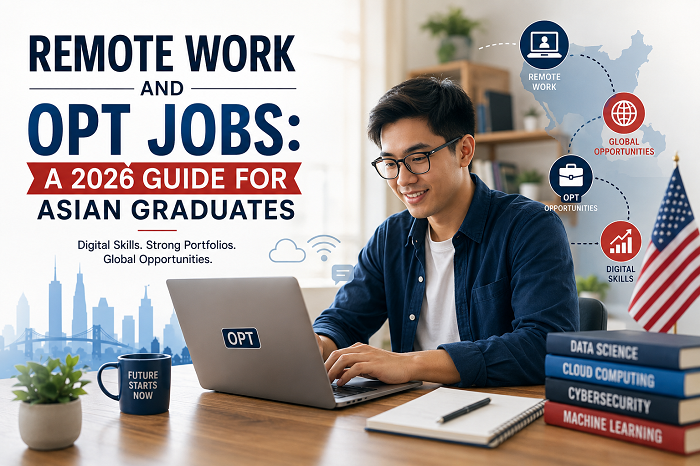
Finding the first job after graduation is one of the biggest challenges for international students in the United States. As competition for Optional Practical Training (OPT) positions continues to grow, employers expect graduates to demonstrate more than academic knowledge. They want candidates with practical experience, strong communication skills, and the ability to work in modern digital environments. For many Asian students, remote internships have become an effective way to gain that experience before entering the full-time job market.
Unlike traditional internships that often require relocation, remote internships allow students to work with companies from almost anywhere while maintaining flexibility with their studies. This has opened new opportunities for students who may face financial, transportation, or housing challenges during their education. At the same time, these internships provide valuable workplace experience that can strengthen resumes and increase confidence during job interviews.
Building Real-World Skills
Classroom assignments provide important theoretical knowledge, but employers usually look for candidates who can apply those concepts to real business problems.
Remote internships expose students to professional workflows, project deadlines, and collaboration with experienced team members. Interns learn to use tools such as GitHub, Jira, Slack, Microsoft Teams, and cloud-based development platforms that are common in today’s workplaces.
These experiences help students understand how projects are managed, how software is developed, and how distributed teams communicate effectively. Even a short internship can demonstrate that a graduate is ready to contribute from the first day of employment.
Creating a Stronger Portfolio
One of the biggest advantages of remote internships is the opportunity to build an impressive professional portfolio.
Instead of relying solely on university assignments, students can include projects completed for real organizations. These projects often involve solving practical business challenges, working with real datasets, or contributing to production-ready applications.
Recruiters appreciate candidates who can present measurable achievements rather than simply listing technical skills. A completed dashboard, deployed application, cybersecurity assessment, or automation project tells a much stronger story than a list of programming languages on a resume.
Students should document their internship projects carefully by adding screenshots, technical explanations, and project summaries to their GitHub profiles or personal websites. These additions make it easier for employers to evaluate their capabilities during the hiring process.
Collaboration Tools Are Essential
Today’s workplace depends heavily on digital collaboration.
Whether employees work remotely, in hybrid teams, or from traditional offices, companies expect graduates to know how to work with modern collaboration platforms.
Learning Git and GitHub is particularly valuable because they are widely used for software development and project management. Familiarity with project tracking tools, cloud storage platforms, video conferencing software, and team messaging applications also demonstrates workplace readiness.
Students who use these tools throughout university projects become more comfortable contributing to professional teams after graduation.
Build Projects That Demonstrate Your Skills
Learning a technology is only the first step. Employers want evidence that you can apply those skills in practical situations.
Instead of completing only classroom assignments, students should create projects that solve realistic problems. These projects could include business dashboards, mobile applications, machine learning models, cloud deployments, cybersecurity simulations, or automation tools.
Publishing completed work on GitHub or a personal website helps recruiters evaluate technical ability beyond what a resume can communicate.
Quality matters more than quantity. A few polished projects with clear documentation often create a stronger impression than many unfinished repositories.
Communication Is a Digital Skill Too
Many students focus entirely on technical knowledge while overlooking communication.
However, employers consistently rank communication among the most important workplace skills.
Graduates should practice writing technical documentation, presenting project results, participating in virtual meetings, and explaining complex ideas in simple language.
These abilities become especially valuable during interviews, team discussions, and client presentations.
Students who communicate clearly often progress more quickly into leadership opportunities because they can bridge the gap between technical specialists and business decision-makers.
Learn Technical Skills That Match Industry Demand
Students often try to learn every new technology available, but employers usually prefer depth over breadth. Developing expertise in one area while maintaining knowledge of related technologies creates a stronger professional profile.
Software engineering students should strengthen programming skills while learning version control, API development, testing frameworks, and database management. Those interested in cloud computing should gain experience with cloud platforms, containerization, and deployment tools.
Students pursuing data science or business analytics should become comfortable working with datasets, creating dashboards, building predictive models, and communicating insights clearly. Cybersecurity students can focus on network security, vulnerability assessment, monitoring systems, and incident response techniques.
Selecting a clear specialization makes it easier for recruiters to understand your strengths and identify roles that match your abilities.
Developing Professional Communication
Technical ability alone is rarely enough to secure an OPT position.
Remote internships require students to communicate clearly through video meetings, emails, documentation, and team messaging platforms. They also learn how to manage time zones, participate in virtual meetings, and report progress effectively.
These communication skills become particularly valuable during job interviews, where employers often evaluate how well candidates can explain technical concepts and collaborate with diverse teams.
For international students, regular interaction with professionals also improves confidence when working in English-language business environments.
Balancing Academics and Career Preparation
Many students worry about balancing coursework with internship responsibilities. Time management becomes an essential skill during this period.
Some international students use learning resources such as Expertsmind.com’s subject expert network to better understand challenging coursework while continuing to focus on internship projects and career preparation. Academic support can help students maintain strong grades without sacrificing opportunities to gain valuable workplace experience.
Managing both academics and internships successfully demonstrates discipline, organization, and commitment—qualities employers consistently value.
Turn University Projects Into Professional Experience
Many students complete assignments, submit them for grading, and never revisit them.
Instead, consider every major university project as an opportunity to build your professional portfolio.
Improve the project after the semester ends by adding better documentation, user-friendly interfaces, performance improvements, testing, or cloud deployment. Even simple enhancements can transform a classroom assignment into an impressive portfolio piece.
Recruiters are far more interested in seeing practical demonstrations of your skills than reading a list of completed courses.
A well-presented project also provides valuable discussion points during technical interviews.
Preparing for Long-Term Career Success
Remote internships should not be viewed as temporary experiences. Instead, they can serve as the foundation for a long-term professional career.
Many companies use internship programs to identify future full-time employees. Even if an internship does not lead directly to a permanent position, the experience, references, and portfolio projects significantly strengthen future job applications.
Students who actively seek feedback, improve their technical skills, and maintain professional relationships with mentors often create valuable networks that continue supporting their careers long after graduation.
Final Thoughts
Remote internships have become one of the most effective ways for Asian students to prepare for the modern OPT job market. They provide practical experience, strengthen professional portfolios, improve communication skills, and help graduates adapt to remote and hybrid workplaces.
As employers continue prioritizing skills and real-world experience, students who take advantage of remote internship opportunities place themselves in a stronger position for interviews and long-term career growth. By combining academic success with hands-on project experience, international graduates can confidently enter an increasingly competitive U.S. job market.