
I remember walking through a mid-sized sales floor a few years ago. About twenty agents, all working an outbound campaign. From a distance, it looked busy enough — people with headsets, screens open, scripts on the desk.
But when you stood there for five minutes, the pattern became obvious.
Dial.
Wait.
Voicemail.
Dial again.
One of the team leads joked that their salespeople had quietly turned into “professional number punchers.” Everyone laughed, but there was some truth behind it. The team was spending more time dialing than actually speaking with prospects.
That’s usually when companies start looking seriously at a predictive dialer.
Not because it sounds fancy, but because outbound campaigns fall apart when conversations are too few and too far apart.
The real bottleneck in outbound sales
People often assume sales problems come from bad scripts or weak leads. Sometimes that’s true. But more often the issue is simpler — not enough real conversations.
A manual dialing setup creates friction everywhere.
An agent finishes a call.
They look at the next number.
Dial it.
Wait through five rings.
Hit voicemail.
Then the cycle starts again.
When you track it over a full shift, the numbers get uncomfortable. Many agents only spend a small portion of their day actually speaking with prospects. The rest disappears into dialing time and unanswered calls.
That’s where automated dialers started gaining traction in outbound teams.
The goal was simple: remove the mechanical part of dialing so agents could focus on the human part of selling.
Where predictive dialing changes things
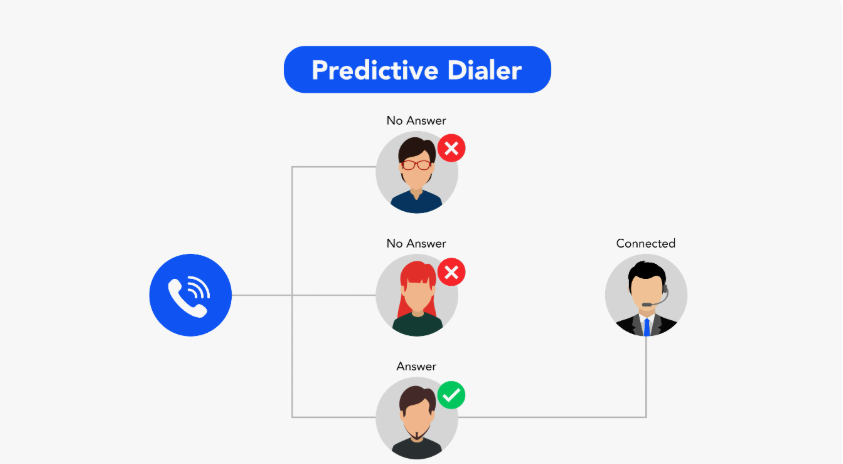
A predictive dialer doesn’t just dial numbers automatically. It studies the behavior of the campaign.
It watches things like:
- how long conversations usually last
- when agents become available
- how often people answer calls
- how quickly the team moves between calls
Based on those patterns, the system starts placing calls slightly ahead of time.
So when an agent finishes one conversation, another answered call is already waiting.
It feels small when you describe it. In practice, it changes the rhythm of an entire sales floor.
Instead of long pauses between calls, agents move directly into the next conversation.
Momentum matters more than most people realize
Sales teams run on energy.
If an agent goes ten minutes without reaching a real person, the tone of the next call changes. Confidence dips. Scripts start sounding robotic. Even strong performers lose momentum.
Back-to-back conversations keep people mentally engaged.
A sales manager I spoke with once described it perfectly. After their team introduced predictive dialing, he said the floor “sounded different.” Less silence. More talking. More activity.
Interestingly, the morale shift showed up before the performance metrics did.
But the numbers eventually followed.
A campaign example that stuck with me
One SaaS company I worked with ran outbound campaigns targeting small business owners. Their agents were good on the phone, but call volume was painfully low.
Each rep managed maybe 35 real conversations a day.
After moving to a predictive dialer setup, the number of daily conversations almost doubled within weeks.
Nothing else changed.
Same lead lists.
Same scripts.
Same salespeople.
The difference was that agents stopped wasting time dialing numbers that would never connect.
More conversations meant more opportunities to qualify prospects. More qualified prospects meant more pipeline.
Sometimes growth is less about tactics and more about removing friction.
Testing sales approaches becomes faster
Outbound campaigns rarely get the script right on the first try.
Teams experiment constantly:
- different opening lines
- new value propositions
- slight changes in tone
- alternative offers
Manual dialing slows this process because it takes a long time to gather enough conversations to see patterns.
Predictive dialing shortens that cycle.
When agents are speaking with far more prospects in a day, managers start spotting trends much faster. A weak opening line becomes obvious. A strong one spreads quickly across the team.
It turns campaign adjustments from slow weekly discussions into daily improvements.
Lead lists stop gathering dust
Another quiet benefit shows up in lead management.
Many companies sit on huge databases of contacts but avoid using them fully. The reason is simple — dialing through massive lists manually takes forever.
With automated dialers, the system can move through low-response numbers quickly and surface the ones that actually answer.
This encourages teams to experiment with broader outreach:
older leads
inactive prospects
regional lists that were previously ignored
Suddenly, that dusty CRM database becomes useful again.
When predictive dialing makes the biggest difference
Not every outbound campaign needs it. But certain environments benefit immediately.
Large outbound teams tend to see the biggest improvements, especially when:
- campaigns involve thousands of leads
- the goal is quick qualification
- agents follow structured conversation flows
- answer rates are unpredictable
In those situations, manual dialing simply can’t keep pace with campaign goals.
A few lessons teams usually learn the hard way
Technology alone doesn’t fix a sales campaign. Predictive dialing works best when a few basics are already handled.
Clean phone data matters more than people expect. Bad numbers waste dialing capacity.
Dial rates also need careful tuning. If the system calls too aggressively, prospects may answer before an agent is free.
Training matters too. When conversations arrive quickly, agents must think fast and transition smoothly between calls.
Teams that prepare for those details tend to see stronger results.
The change sales leaders notice first
Ask managers what surprised them most after introducing predictive dialing, and the answers are rarely about dashboards or analytics.
They talk about the atmosphere.
The sales floor becomes louder. Conversations overlap. Agents stay engaged throughout the day instead of drifting between long silent gaps.
Outbound campaigns begin to feel active again.
And when a team spends more time speaking with real prospects instead of dialing numbers, sales results usually follow not long after.
 Contributor